Axe throwing has grown from a novelty bar game into one of the fastest growing target sports in the country, with hundreds of dedicated venues now open in most mid-size cities. If you’ve walked past one of these spots and wondered whether you could actually learn to stick an axe in a wooden target, the answer is yes. Most first-timers land a bullseye within their first ten throws, and no prior experience is required.
This guide covers what axe throwing actually costs, how a beginner should approach a first session, the mistakes almost everyone makes early on, and the safety rules that keep the sport injury-free. Axe throwing often shows up on lists of adrenaline hobbies for thrill seekers, but it is far more accessible and low-pressure than that label suggests.
Disclosure: some links on this page are Amazon affiliate links. As an Amazon Associate I earn from qualifying purchases.
Axe throwing for beginners means booking a one-hour lane session at a licensed venue, where a staff coach teaches the two-handed grip, stance, and release before anyone throws for score. A typical first session costs $25 to $40 per person and includes all equipment and instruction. No prior experience, membership, or personal gear is required to get started.
In This Guide
- What Is Axe Throwing
- What It Costs to Start
- How to Get Started
- Beginner Mistakes to Avoid
- Is Axe Throwing Right for You
- FAQ: Axe Throwing
What Is Axe Throwing
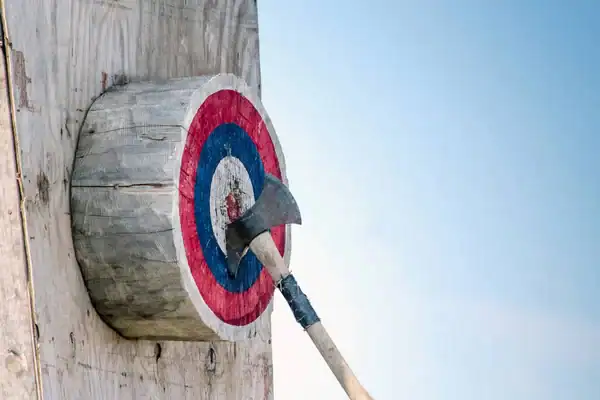
Axe throwing is a target sport where competitors throw a hatchet or throwing axe at a wooden target, aiming for a bullseye much like darts or archery. Most targets use a ringed scoring system, with the center bullseye worth the most points and outer rings worth progressively less.
Axe throwing traces its indoor venue popularity back to Canada in the early 2010s, when the first commercial urban axe throwing lounges opened and quickly spread across the United States. What began as a handful of venues has grown into an international sport with organized leagues, regional tournaments, and a world championship circuit.
A typical throwing axe used at venues is a single-bladed hatchet weighing about a pound and a half to two pounds, with a wooden handle roughly 14 to 19 inches long. Big axe divisions use a heavier, longer-handled axe thrown from farther back, but nearly every beginner starts with the standard hatchet division instead.
Competitive formats add small kill shot markers in the top corners of the target, worth bonus points when hit under match rules. The sport is governed internationally by organizations including the World Axe Throwing League, which sets official target dimensions, axe specifications, and safety standards that most venues follow.
A typical league match pits two throwers against each other over several rounds, with points tallied after each round on the ringed target. Recreational venues usually skip formal scoring for walk-in guests and instead let the coach run informal games like tic-tac-toe or knockout, which keep the session fun without requiring anyone to learn the full rulebook on their first visit.
Casual walk-in sessions use the same lane setup as league play, just without the scoring pressure or tournament format. Because the sport rewards consistent technique over raw strength, it has quietly become something of a problem-solving hobby. Small adjustments to throwing distance and release timing fix most accuracy issues, which is part of what makes it so satisfying to practice.
What It Costs to Start
Cost to start: expect $25 to $40 for a single venue session, or $80 to $200 for a basic home setup.
Walk-in sessions at most axe throwing venues run $25 to $40 per person for about an hour of lane time. That price usually includes basic coaching, all axes, and unlimited throws during your slot. Group and party packages typically range from $30 to $50 per person.
Corporate or private events cost more once catering, a private room, and dedicated staff get added in, often landing between $40 and $75 per person. If a local venue runs a league, joining typically costs $120 to $150 for an eight to ten week season, sometimes with a small separate registration fee paid to the governing league body. That works out to roughly $15 to $20 per week of play.
Pricing also varies by market. Sessions in large metro areas like New York, Los Angeles, and Chicago can push toward $40 to $45 per person even without add-ons, while smaller markets and suburban venues are often closer to $20 to $28 per person for the same hour. It’s worth comparing a couple of nearby options before booking if budget is a factor.
Expect to tip your coach a few dollars per person if the venue allows it, similar to bowling or mini golf staff, though it is not mandatory everywhere. Some venues also sell snacks and drinks separately from the session price, which can add another $10 to $20 to a night out. As a rough total, a solo first-timer paying $30 for a session, tipping $5, and grabbing a drink spends about $45 to $50 for a full evening out.
Compared to other adrenaline-adjacent activities like indoor skydiving or go-karting, axe throwing is on the cheaper end for a first try, while still delivering the physical, hands-on feeling those other hobbies chase. That makes it an easy entry point if you are testing whether higher-adrenaline hobbies are worth pursuing further.
A basic home setup (target and axes bundle) runs $80 to $200 total if you want to practice outside of venue hours. A single beginner-friendly throwing axe costs $50 to $90, cottonwood or pine target boards and lumber for a simple frame run another $50 to $100, and an official stencil and marker kit for painting target rings adds roughly $30 to $40.
Premium competition axes climb toward $120 to $190, but nothing a beginner needs to spend right away. A mid-range hatchet paired with a homemade plywood target is enough to practice grip, stance, and release in a garage or backyard, provided your yard has the legal and physical space for it.
A couple of small accessories make home practice easier without adding much to the total. A leather sheath to protect the blade in storage runs $10 to $20, and a sharpening stone or file to maintain the edge costs another $10 to $15. Neither is required to start, but both extend the life of a home axe.
Some homeowners insurance policies exclude injuries from thrown-weapon activities, so it is worth a quick call to your provider before building a permanent target. If you are hosting friends to throw in your backyard regularly, ask specifically about liability coverage rather than assuming a standard policy applies.
How to Get Started
Getting started takes less setup than most people expect. Here is the order that works for almost every first-timer.
- Find a venue or league. Search for an axe throwing venue near you, and check whether it is affiliated with a group like the World Axe Throwing League, which generally means certified coaches and standardized safety rules. Read a handful of recent reviews about coaching quality specifically, since that matters more to a beginner’s experience than the decor or drink menu. Book a one-hour walk-in session before committing to a league.
- Wear the right clothes. Closed-toe shoes are mandatory at almost every venue, and most also ban loose sleeves, dangling jewelry, and open-toed sandals. Comfortable pants and a fitted top give you the most freedom of motion during the throw.
- Learn the basic two-handed throw. Grip the axe handle near the bottom with both hands, keeping your hold relaxed rather than clenched. Raise the axe back over your head, step forward with your non-dominant foot, and release it while your arms are extended toward the target, letting it roll off your fingers rather than flicking your wrist.
- Learn to read your own throw. If the axe hits the target handle-first, you are standing too close and need to step back. If it smacks the board flat without sticking, you are too far away and need to step in, since either mistake usually just means your rotation and distance are slightly out of sync.
- Follow the house safety rules without exception. Never step into the target lane while anyone else is holding an axe, and never retrieve your axe until a coach or the person you are throwing with signals it is clear. These two rules prevent almost every injury that happens at axe throwing venues.
- Book a second session or join a league. Most people improve noticeably between their first and second visit, since the initial session is often spent adjusting to the axe’s weight and swing. If you enjoy it, ask the venue about league nights, which run in structured seasons and match you against other members of similar skill.
Most venues build all of this into the first fifteen minutes of a walk-in session, so nobody is expected to arrive already knowing any of it. The coaching is part of what you are paying for, not an optional add-on.
Beginner Mistakes to Avoid
A handful of mistakes account for most of the missed throws and stuck-blade frustration beginners run into early on. Most of them are easy to fix once a coach or a more experienced friend points them out.
- Gripping the handle too tightly. A death grip slows the axe’s rotation and throws off your release timing. Hold it the way you would hold a golf club, firm but not tense.
- Standing at the wrong distance. Most beginners start about twelve feet from the target for a two-handed throw. If the axe is hitting handle-first, step back; if it is bouncing off flat, step forward.
- Flicking the wrist on release. The throw should come from the shoulder and elbow, with the wrist staying locked in line with the forearm. A wrist flick throws off rotation and is the single most common reason axes bounce out.
- Skipping the follow-through. Stopping your arm motion right at release shortens the throw and reduces accuracy. Let your arm continue naturally toward the target after the axe leaves your hand.
- Throwing side-arm instead of overhead. A side-arm throw is harder to control and increases the chance the axe glances off the target instead of sticking. Stick with the standard overhead two-handed throw until your accuracy is consistent.
- Choosing a heavier axe to look impressive. A lighter standard hatchet is easier to control while you are still learning technique. Ask the coach which axe on the rack is recommended for first-timers, and start there.
- Rushing the throw. Beginners often rush to keep pace with a group, which throws off the timing of the release. Take an extra second to reset your stance before every throw, especially early on.
- Comparing yourself to experienced throwers too early. League members and regulars have hundreds of throws of muscle memory that a first-timer has not built yet. Judge your own progress across a single session rather than against someone else’s best throw.
- Ignoring the coach’s signals. New throwers sometimes get impatient and start walking toward the target before it is confirmed safe. Wait for the explicit go-ahead every single time, no exceptions.
Is Axe Throwing Right for You
Axe throwing works well as a low-commitment hobby you can try once and walk away from, or build into a regular weekly habit. It is often grouped alongside other best hobbies for guys lists, though plenty of women, couples, and mixed groups take it up too, especially through birthday parties and corporate team events.
If you like the visceral, slightly edgy appeal of throwing a sharp object at a target, axe throwing shares some DNA with the scary, dark, and creepy hobbies that let people flirt with controlled risk in a safe setting. For a lower-cost option that does not require a venue every time, a home target setup fits neatly alongside other hobbies for men at home.
The format also works well for people who don’t consider themselves particularly athletic. Coordination and a good coach matter more than fitness level, which is part of why it has become a common choice for office outings, bachelor and bachelorette parties, and first dates looking for something more active than dinner.
Budget-wise, axe throwing sits in a comfortable middle ground. It costs more than something like hiking, but less than a full day of skiing or a round of golf at a nice course. A single walk-in session is a reasonable one-time expense, and it’s worth trying that before committing to a full league season.
The sport is low-impact on joints compared to something like rock climbing, but it does require a full shoulder rotation on every throw, which can aggravate an existing shoulder injury. If you have shoulder or rotator cuff issues, mention it to the coach before your session so they can adjust your stance and distance.
It is probably not the right fit if you are looking for something quiet, solo, or low-impact, since most of the appeal comes from the social, slightly competitive energy of throwing with a group. If you are still weighing it against other options, the full master list of interests and hobbies is worth browsing before you commit to any single one.
FAQ: Axe Throwing
Is axe throwing dangerous for beginners?
Axe throwing carries real risk since you are handling a sharp weighted blade, but injuries are rare at licensed venues that enforce lane rules and staff coaching. Most incidents happen when someone ignores retrieval signals or steps into an active lane. Following the venue’s safety briefing closes almost all of that risk gap.
Do I need to bring my own axe?
No. Every venue provides axes, targets, and instruction as part of the session price, so you do not need any personal gear for a first visit. Buying your own axe only makes sense once you know you want to practice at home between sessions.
How long does a first session last?
Most walk-in sessions run about one hour, which is typically enough time for instruction plus twenty to thirty throws per person in a small group. Party and league sessions can run longer, often ninety minutes to two hours.
Can kids do axe throwing?
Age minimums vary by venue and by state, but many venues allow throwers as young as ten to fourteen with a parent present, while some set the minimum at eighteen. Check the specific venue’s policy before booking, since this is one of the least standardized rules in the sport.
What does axe throwing cost for a group?
Group pricing usually mirrors individual pricing, so a group of six paying $30 per person would spend around $180 total for an hour of lane time. Larger groups of ten or more often qualify for a discounted per-person rate, and many venues offer dedicated party packages that bundle food and extra time.
Is axe throwing a good workout?
Axe throwing raises your heart rate slightly and works your shoulders, core, and legs through repeated throwing motion, but it is not a substitute for cardio or strength training. Most people feel it more in their shoulders and forearms the next day than during the session itself.
Do venues require a reservation?
Many venues accept walk-ins, but weekends and evenings fill up fast, especially for groups of four or more. Booking a lane online a few days ahead guarantees your time slot and avoids a wait once you arrive.