If you have ever finished a jigsaw puzzle and thought “I bet I could do that faster,” you have already found the entry point into speed puzzling. It is exactly what it sounds like, solving a jigsaw puzzle, usually 500 pieces, against a clock, either alone, with a partner, or on a team of four. What started as bragging rights among puzzle enthusiasts has turned into an organized sport with regional meetups, a national championship, and a world championship held in Spain every year.
This guide is for the casual puzzler who just found out this is a real competitive hobby and wants to know how it actually works before buying anything or signing up for anything. No fluff, no invented war stories, just what speed puzzling costs, how the competitions are structured, and the techniques that separate a 90 minute finish from a 30 minute one.
Speed puzzling is timed jigsaw solving, most commonly on identical 500 piece puzzles, in solo, pairs, or four person team divisions, judged purely on who finishes first. A casual puzzler typically needs 1.5 to 4 hours for a 500 piece puzzle, while trained competitors finish the same puzzle in well under an hour. You can start for the cost of a puzzle you already own, and the fastest way in is a casual bar or cafe puzzle night, not a plane ticket to a championship.
If competitive jigsaw puzzling turns out not to be your thing, my master list of hobbies has hundreds of other low cost ways to spend an evening.
Table of Contents
- What Is Speed Puzzling?
- How Competitions Work
- What It Costs to Start
- How to Get Started
- How to Get Faster
- Beginner Mistakes to Avoid
- Is Speed Puzzling Right for You?
- FAQ
What Is Speed Puzzling?
Speed puzzling is jigsaw puzzling with a stopwatch attached. Instead of assembling a puzzle at your own pace over a weekend, everyone in a heat receives the same puzzle, usually sealed in an opaque bag or box so nobody gets a preview, and races to place the last piece. The organization that has done the most to formalize the sport in the United States is the USA Jigsaw Puzzle Association, which serves as the country’s official liaison to the World Jigsaw Puzzle Federation and runs national rankings, an annual online competition, and free casual contests at its monthly puzzle club meetups.
The sport has an actual world stage. The World Jigsaw Puzzle Championship has been held in Valladolid, Spain, drawing hundreds of competitors from dozens of countries for a weekend of individual, pairs, and team events. It is not a fringe curiosity either. A Washington Post feature described competitive speed puzzling as reshaping what used to be a relaxing, solitary pastime into a genuine spectator sport, and outlets from local news stations to Guinness World Records now track official times.
At its core, though, speed puzzling is still just puzzling. It rewards the same pattern recognition and visual sorting that make jigsaw puzzles satisfying in the first place, which is why they show up as a classic example in my guide to problem solving hobbies. Competition just adds a clock and a community around getting good at it.
How Competitions Work
Every legitimate speed puzzling competition follows roughly the same format, whether it is a casual bar night or an official championship.
Everyone gets the same puzzle. Organizers deliberately choose an image nobody has seen before, often an unreleased design, so no competitor has a memory advantage. Puzzles are sealed until the start signal.
There are three main divisions. Individual competitors work alone. Pairs teams of two work together on a shared puzzle. Team divisions typically involve four people working the same puzzle at once, which requires its own coordination skills on top of raw solving speed.
Piece count depends on the division. Individual events commonly use 500 piece puzzles with a time limit around 90 minutes, while team events at the World Championship have teams of four tackling two 1000 piece puzzles within a set window. Local and online contests run smaller and larger counts too, but 500 pieces is the benchmark size across most of the sport.
Trays are allowed, but regulated. Competitors sort pieces onto flat trays rather than working directly on the table, and official rules cap how much tray space you can use. For a 500 piece puzzle, competitors are typically limited to two trays no larger than roughly A3 size (about 16.5 by 11.7 inches). This keeps the contest about solving skill rather than table real estate.
Scoring is by finish time, with a fallback. Whoever places the final piece first wins the heat. If someone does not finish within the time limit, judges count the remaining unplaced pieces to rank unfinished attempts, so nobody is scored as a total blank.
Big events run in waves. National championships often start with several preliminary rounds of a couple hundred puzzlers each, with only the fastest finishers from each round advancing to a final table. It is closer in structure to a track meet than a chess tournament, heats first, finals second.
None of this requires you to be a “real” competitor to try. Most local speed puzzling nights use the exact same rules as a scaled down, lower pressure version of the format above.
What It Costs to Start
Speed puzzling is one of the cheaper competitive hobbies you can pick up.
Disclosure: some links on this page are Amazon affiliate links. As an Amazon Associate I earn from qualifying purchases.
- Puzzles. A standard 500 to 1,000 piece cardboard puzzle from brands like Ravensburger, EuroGraphics, or MasterPieces runs about $10 to $25. This is your only real recurring cost, and you likely already own a few.
- Trays. A basic sorting tray set runs $10 to $25, though a baking sheet or shallow box works fine while you decide if you like the sport.
- Events. Casual puzzle nights at bars, breweries, and puzzle shops are typically free or a few dollars for a drink minimum. Official regional and national events usually charge a modest entry fee, generally well under $100.
- Travel. The only significant cost most puzzlers ever face is optional travel to a national or world championship, and plenty of competitive puzzlers never make that trip.
There is no required subscription, no proprietary equipment, and no gatekeeping gear tier. A $15 puzzle and a kitchen table are enough to start training tonight.
How to Get Started
1. Buy or dig up a 500 piece puzzle you have not seen. Avoid a puzzle you have solved before, since the point is practicing real solving speed, not recalling where pieces go. A clear, high contrast image is easier to start with than a puzzle full of solid sky or ocean.
2. Time yourself on a normal solve first. Before worrying about technique, solve one puzzle at a relaxed pace with a stopwatch running just to get an honest baseline. Most first timers land somewhere between 1.5 and 4 hours for 500 pieces.
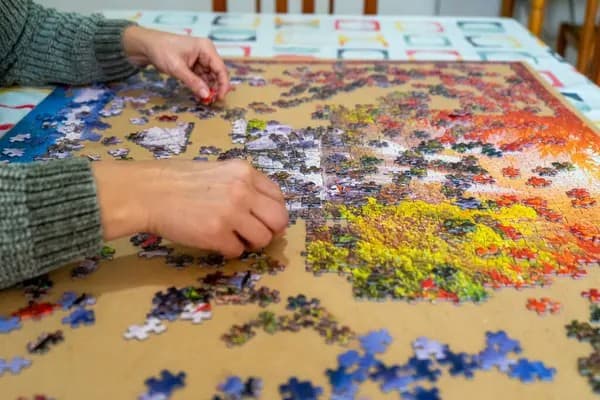
3. Learn the flip and sort routine. Dump every piece face up, separate the edge pieces from the interior pieces, and start grouping interior pieces loosely by color or pattern as you go. This single habit is behind most of the time savings you will see early on.
4. Find one local or online event. Search Facebook Events and Meetup for “speed puzzling” or “puzzle night” in your area, or check whether a nearby brewery, board game cafe, or bookstore hosts one. The USA Jigsaw Puzzle Association and speedpuzzling.com both list ongoing events and casual club meetups if nothing turns up locally.
5. Do a timed solo run every week or two. Consistency matters more than any single trick. Track your times on a handful of different puzzles and watch the trend rather than obsessing over one result.
6. Try a pairs puzzle with a partner. Pairs competition adds a coordination skill on top of solving speed, since you need to divide the puzzle mentally without talking over each other. It is also, honestly, the most fun division to start in.
How to Get Faster
This is where speed puzzling stops being luck and starts being a trainable skill.
Sort before you build. The single biggest time sink for beginners is picking up the same piece five times because it was never sorted. Flip every piece face up first, pull all the edges into one pile, then sort the rest loosely by dominant color or pattern. This “flip and sort” phase can eat ten or fifteen minutes on a 500 piece puzzle, but it pays that time back many times over during assembly.
Pick a strategy and commit, edges first or color blocks first. Puzzlers genuinely disagree on which comes first, and both are legitimate. Edges-first gives you a fixed frame that makes placing interior pieces easier to judge by position.
Color-block-first lets you build several finished sections simultaneously and skip the border until the end, which can be faster on puzzles with a busy or low contrast border. Try both approaches on different puzzles and see which one your brain naturally does faster, then stick with it instead of switching mid solve.
Use trays that let pieces slide. A tray with a raised lip on all four sides slows you down because you have to lift pieces out one at a time. Trays that are flat or open on at least one edge let you slide pieces around with your fingers, which shaves real time off a competitive solve.
Work in clusters, not one border and one region at a time. Rather than completing the whole edge before touching the middle, many fast solvers build the edge in sections and simultaneously start two or three interior color clusters, connecting the pieces once several chunks exist. This keeps your hands busy instead of hunting for the one missing edge piece.
Practice piece recognition, not just assembly. A big part of what separates a 35 minute solver from a 90 minute solver is how fast their eyes match a shape and color to its spot without consciously thinking about it. That comes from repetition, not from a clever hack. Solving one or two timed puzzles a week for a couple months will do more for your speed than any single tip.
Know your two trays limit if you plan to compete. Since official 500 piece events cap you at two trays around A3 size, practicing with that same constraint at home avoids a nasty surprise on competition day, when a beginner used to spreading pieces across the whole table suddenly cannot.
Beginner Mistakes to Avoid
Solving a puzzle you have done before. It feels productive but teaches you nothing about real speed, since you are pattern matching from memory instead of from the image.
Skipping the sort phase to “just start.” It feels faster in the moment and is almost always slower overall. Discipline during the first five minutes saves far more than five minutes later.
Copying someone else’s exact method without testing it. Edge-first, color-first, and hybrid approaches all have fast practitioners. Watching one video and assuming that method is universally best skips the part where you find out what actually works for your own eye.
Ignoring lighting. Good, even, glare free lighting has a bigger effect on solving speed than most beginners expect, since color and pattern matching depend on being able to actually see subtle differences between similar looking pieces.
Treating one bad time as proof you are not good at this. Times vary a lot puzzle to puzzle based on image difficulty, color palette, and piece cut style. Track a rolling average over several solves instead of judging yourself off a single rough one.
Is Speed Puzzling Right for You?
Speed puzzling suits people who already like jigsaw puzzles but want a reason to sit down and actually finish one instead of letting it sit half done on the table for a month. It also appeals to people who enjoy quiet, low cost competition without needing a team roster or a season commitment.
It is a genuinely accessible hobby. There is no physical fitness requirement, the entry cost is close to zero if you already own a puzzle, and both solo and social formats exist depending on your mood. That accessibility is part of why it fits naturally alongside other calm, cognitively engaging pastimes I cover in my guide to hobbies for men at home, and why it keeps showing up as a recommendation in lists of hobbies for men over 60, since it demands focus and pattern recognition rather than mobility.
If you would rather relax with a puzzle than race one, that is a completely valid choice, and nothing about casual puzzling requires you to ever touch a stopwatch. But if you have ever felt a small competitive itch while hunting for that last corner piece, speed puzzling gives that itch somewhere legitimate to go, complete with a community, a ranking system, and, if you get good enough, a shot at a table in Spain. It also holds up fine as a solo pursuit if group competition never appeals to you, alongside other low key options in my list of best hobbies for guys.
Puzzling Is Better With a Clock and a Community
Speed puzzling takes a hobby most people already own the equipment for and turns it into something with real structure: divisions, rankings, a national championship, and a genuine world stage. None of that requires buying anything expensive or traveling anywhere. It requires one puzzle, a stopwatch app on your phone, and a willingness to time yourself honestly.
Start with a solo timed solve this week. If it hooks you the way it hooks most people who try it, a local puzzle night is the natural next step, and the national and world championships are there waiting whenever you are ready for them. For more low cost, mentally engaging ways to spend your evenings, my master list of hobbies covers hundreds more.
FAQ: Speed Puzzling
What is speed puzzling?
Speed puzzling is competitive jigsaw puzzling where everyone solves an identical, previously unseen puzzle under a time limit, either alone, in pairs, or on a four person team. Whoever places the final piece first wins the heat, and organizations like the USA Jigsaw Puzzle Association run official rankings and events built around this format.
How long does it take to finish a 500 piece puzzle competitively?
Casual puzzlers typically take 1.5 to 4 hours for a 500 piece puzzle, while trained competitors regularly finish the same puzzle in under 40 minutes. Elite individual times at the World Jigsaw Puzzle Championship have dropped into the low 30 minute range, though most competitors at any given event land somewhere between those extremes.
Do I need special puzzles or trays to compete?
No special puzzles are required, though official events specify a maximum piece count and tray size for each division, generally two trays around A3 size for a 500 piece puzzle. Any standard cardboard jigsaw puzzle works for practice, and a basic sorting tray or even a baking sheet is enough to start.
Where can I find a speed puzzling competition near me?
Check Facebook Events and Meetup for “speed puzzling” or “puzzle night” in your city, and look at whether local breweries, board game cafes, or puzzle shops host casual contests. The USA Jigsaw Puzzle Association and speedpuzzling.com both maintain event listings and monthly club meetups for puzzlers who cannot find anything nearby yet.