Are you looking to add more of a rush to your free time? If your current hobbies feel a little too calm, there are plenty of adrenaline hobbies built for exactly that itch. Whether you’re a total beginner or already chasing bigger thrills, this list breaks down thirteen ways to get your heart pumping, along with what each one actually costs and how hard it is to learn.
Adrenaline hobbies for thrill seekers range from low-cost, backyard-friendly options like slacklining and axe throwing to bigger commitments like flyboarding and hang gliding, and most of them can be tried for under $150 before you decide whether to invest further. The common thread is controlled risk: each activity pushes your body and nerves while relying on gear, training, or a guide to keep things safe. Start with something local and cheap, then work up to the bigger stuff once you know you’re hooked.
If you want the full picture of where adrenaline hobbies fit among hundreds of other options, check out our master list of interests and hobbies for the complete rundown.
Table of Contents
- 1. Slacklining
- 2. Flyboarding
- 3. Axe Throwing
- 4. Mountain Biking
- 5. Boxing
- 6. Parkour
- 7. Hang Gliding
- 8. Bouldering
- 9. Ziplining
- 10. Bodysurfing
- 11. Spearfishing
- 12. Extreme Pogo
- 13. Whitewater Rafting
Adrenaline Hobbies to Get Your Blood Flowing
1. Slacklining
Cost to start: $30-$70 | Difficulty: Moderate
Slacklining is the art of walking along a length of flat nylon or polyester webbing stretched and anchored between two points, usually trees or posts. Unlike a tightrope, a slackline has real give in it, so it sways and bounces underfoot, which is what makes it both harder to master and more fun once you do. A basic beginner kit with webbing, ratchets, and tree protectors runs $30-$70, and you do not need a gym membership or instructor to start.
The learning curve is steep for the first few sessions since your body has to relearn balance from scratch, but most people can walk several steps within a week of short daily practice. First step: buy a beginner slackline kit and set it up low, about a foot off the ground, in a backyard or park.
2. Flyboarding
Cost to start: $100-$250 | Difficulty: Moderate
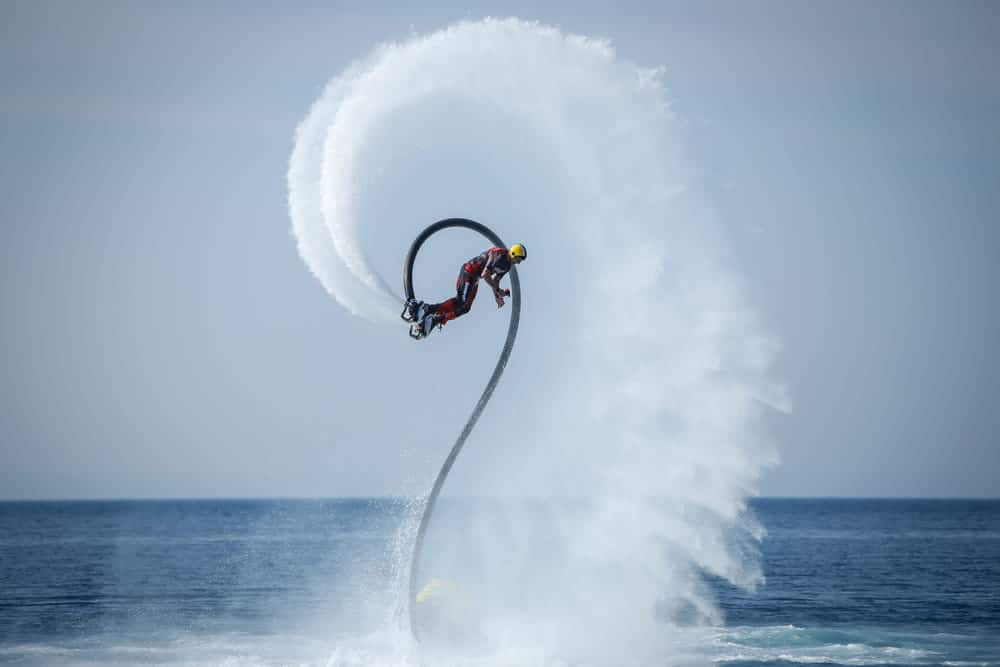
Flyboarding straps you to a board connected by a hose to a jet ski, which pumps water down through the board to launch you several feet above the surface. Once you get the hang of balance and throttle control, you can hover, dive underwater, and even do flips. Because it requires a jet ski, compressor, and certified instructor, this is not a hobby you do from home, most operators charge $100-$250 for a 30 to 60 minute session including all gear and instruction.
It is one of the more physically demanding entries on this list since your core has to constantly adjust to stay upright. First step: book an introductory flyboarding lesson at a coastal or lakeside water sports operator.
3. Axe Throwing
Cost to start: $20-$40 | Difficulty: Easy
Axe throwing puts a hatchet in your hand and a wooden target across the room, and the goal is simple: stick the blade, not the handle. Most axe throwing venues charge $20-$40 per person for an hour-long session, which includes axes, coaching on grip and release, and a lane to yourself or with a group. It is one of the more approachable adrenaline hobbies here because the skill ceiling is forgiving, most beginners land a solid throw within their first ten tries, while the release of actually hurling something sharp gives a genuine rush.
Leagues exist in most cities if you want to turn it into a regular hobby. First step: book a walk-in session at a local axe throwing venue.
4. Mountain Biking
Cost to start: $400-$1,500 | Difficulty: Moderate
Mountain biking takes a rugged, suspension-equipped bike onto dirt trails, rock gardens, and drops that would destroy a road bike. Entry-level hardtail mountain bikes start around $400-$700, while full-suspension bikes built for rougher terrain run $1,000-$1,500 or more, and most trail systems are free to ride once you own a bike and helmet. The adrenaline comes from speed and technical obstacles, roots, switchbacks, small jumps, that demand quick decisions and constant balance adjustments.
Beginners should stick to green and blue-rated trails before progressing to black diamond terrain. First step: rent a hardtail mountain bike and try a beginner-friendly trail at a local park.
5. Boxing
Cost to start: $50-$150 | Difficulty: Moderate
Boxing pairs a full-body workout with the raw intensity of hitting (and getting hit by) another person under controlled rules. Most gyms charge $50-$150 a month for group classes, and a basic setup of hand wraps, gloves, and mouthguard adds another $50-$80 up front. Sparring is optional at most gyms and usually only introduced once you have the fundamentals down, so you can get the conditioning and adrenaline of hitting pads and a heavy bag long before anyone throws a punch back at you. First step: sign up for a beginner boxing class at a local gym and buy a basic pair of wraps and gloves.
6. Parkour
Cost to start: $30-$100 | Difficulty: Hard
Parkour turns the everyday urban environment, walls, railings, stairwells, into an obstacle course you vault, climb, and jump across as efficiently as possible. Most parkour gyms charge $30 for a single class or $70-$100 a month for unlimited sessions, and beginners train on padded mats before ever attempting anything on concrete. It demands serious body control, spatial awareness, and the kind of problem solving you will also find in our list of problem solving hobbies, since every obstacle is really a puzzle about the fastest, safest way through.
Progress is gradual and injury risk is real if you skip fundamentals, so a structured class beats teaching yourself from videos. First step: find a parkour gym near you and take an intro class.
7. Hang Gliding
Cost to start: $150-$300 | Difficulty: Hard
Hang gliding straps you into a harness under a fabric-and-frame wing and launches you off a ramp or hillside to soar on air currents. A tandem introductory flight with a certified instructor, where you are along for the ride while they handle the technical flying, costs $150-$300 depending on location and altitude. Full solo certification is a much bigger investment in time and money, but the tandem flight alone delivers the free-falling, wind-in-your-face sensation that makes this one of the purest adrenaline hobbies around.
Weather and wind conditions matter a lot, so flights get rescheduled more often than other activities on this list. First step: book a tandem hang gliding flight at a certified flight park.
8. Bouldering
Cost to start: $25-$45 | Difficulty: Moderate
Bouldering is rock climbing without the ropes, done on shorter walls with thick crash pads below in case you fall. A first visit to a climbing gym typically runs $25-$45 including a day pass and shoe rental, and many gyms bundle everything into a first-timer deal closer to $20-$30. It builds grip strength, problem-solving, and body awareness fast, since every route, called a “problem” for good reason, forces you to figure out the sequence of holds before your arms give out.
It is a great low-commitment entry point if you are not sure a full harness-and-rope climbing hobby is for you yet. First step: buy a day pass at a bouldering gym and take the beginner orientation.
9. Ziplining
Cost to start: $50-$150 | Difficulty: Easy
Ziplining clips you to a pulley on a steel cable and lets gravity do the rest, sending you flying over canyons, forests, or coastlines at speeds that can hit 30-50 mph on longer lines. Most zipline tours charge $50-$150 per person depending on the number of lines and total length, and no experience is required since guides handle the harnessing and braking. It is one of the most accessible adrenaline hobbies on this list because the physical demand is low, you are along for the ride, but the sensation of flying through open air is as intense as anything here. First step: book a zipline canopy tour at an adventure park near you.
10. Bodysurfing
Cost to start: $30-$80 | Difficulty: Moderate
Bodysurfing strips surfing down to just you and the wave, no board, just fins, timing, and enough nerve to commit to a breaking wave. A pair of swim fins built for bodysurfing runs $30-$80, making it one of the cheapest ways to get a genuine ocean adrenaline rush. The hard part is not the gear, it is reading waves correctly and knowing when to paddle, since getting the timing wrong means a mouthful of sand instead of a ride.
Beginners should start at a beach with lifeguards and smaller, well-formed waves before working up to bigger surf. First step: buy a pair of bodysurfing fins and practice at a lifeguarded beach with moderate waves.
11. Spearfishing
Cost to start: $400-$900 | Difficulty: Hard
Spearfishing means free diving underwater and hunting fish with a pole spear or speargun instead of a hook and line. A basic beginner setup, mask, fins, wetsuit, and a simple pole spear, runs $400-$900, and costs climb from there with a boat or gas money to reach good spots. It demands strong breath-holding, calm underwater composure, and real hunting patience, which makes it feel like one of the more primal entries on this list of adrenaline hobbies.
Local spearfishing shops and clubs are the fastest way to learn safe diving practices and legal size and species limits. First step: take a beginner freediving or spearfishing course before buying a full gear set.
12. Extreme Pogo
Cost to start: $400-$500 | Difficulty: Hard
Extreme pogo takes the childhood toy and rebuilds it with a compressed-air spring system that launches riders 5 to 10 feet in the air, high enough for backflips and grinds on rails and ramps. A performance extreme pogo stick costs $400-$500, considerably more than a toy-store version, because the air spring has to handle far more force and repetition. It is a niche but genuinely thrilling hobby with an active online community sharing tricks and progression tips, and the skill floor is higher than it looks since staying upright at height takes real core control. First step: buy an extreme pogo stick built for jumping, not a kids’ model, and practice basic bounces on flat pavement.
13. Whitewater Rafting
Cost to start: $65-$150 | Difficulty: Moderate
Whitewater rafting sends a crew down a rushing river in an inflatable raft, paddling together through rapids rated from mellow class I to violent class V. A half-day guided trip runs $65-$150 per person depending on the river and rapid class, with full-day and multi-day trips costing more. Guides handle route-finding and safety, but everyone paddles, so it is a genuine workout as much as a thrill ride, and the unpredictability of the water is what keeps it exciting even after multiple trips.
It is also one of the more social adrenaline hobbies here, best done with a group of friends splitting a guided tour. First step: book a half-day guided whitewater rafting trip through a licensed outfitter.
Get That Heart Pumping
Adrenaline hobbies don’t have to mean skydiving out of a plane on day one. Most of the options above start at under $150 and let you test the waters before committing serious money or time. If you’re building out a broader rotation of hobbies alongside these, our guides to best hobbies for guys and best hobbies for men in their 20s cover plenty of lower-key options to balance out the high-intensity days.
And if the appeal is more about novelty and edge than pure adrenaline, our list of scary, dark, and creepy hobbies covers a different kind of thrill entirely. For something competitive but far gentler on the body, padel is worth a look too.
FAQ: Adrenaline Hobbies
What is the cheapest adrenaline hobby to start?
Axe throwing and bouldering are the cheapest entry points, both costing $20-$45 for a first session with all gear provided. Slacklining is even cheaper long-term since a $30-$70 kit lasts indefinitely and needs no venue fees.
Are adrenaline hobbies safe for beginners?
Most are safe when done through a certified instructor or guide, since operators for activities like flyboarding, hang gliding, and whitewater rafting carry insurance and follow strict safety protocols. The riskier hobbies to self-teach are parkour and spearfishing, both of which benefit from structured lessons before you push intensity.
Which adrenaline hobby is best for someone with no athletic background?
Ziplining and whitewater rafting are the most beginner-friendly since guides handle the technical work and you don’t need prior fitness or skill. Axe throwing is also approachable since it is more about technique than physical conditioning.
Do I need to live near mountains or the ocean to try these?
No. Axe throwing, boxing, bouldering, parkour, and extreme pogo can all be done in most cities regardless of geography. Flyboarding, hang gliding, spearfishing, bodysurfing, and whitewater rafting do require specific terrain or water access, so those are better suited to a trip or day out rather than a weekly local hobby.